Deal Sharing Aunt Interviews Holly
21st June 2026
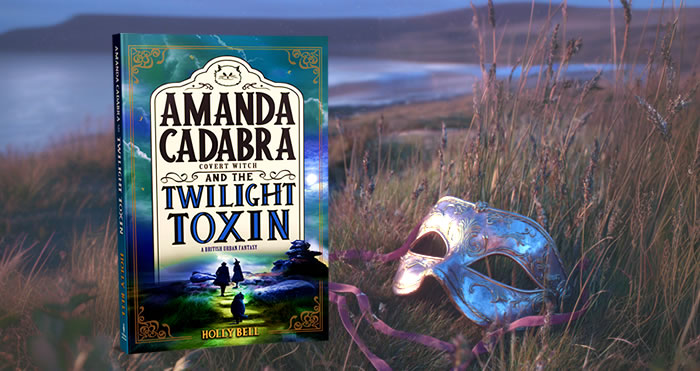
as part of The Great Escapes Virtual Blog Tour for Amanda Cadabra and The Twilight Toxin by Holly Bell
1. When did you first realize you wanted to be a writer?
At 19, when I co-authored a science fiction book. A friend of a friend who worked for a publisher read it and was, probably rightly, not encouraging. Fiction writing was consigned to a drawer for decades. It was at university that I discovered a talent for research and academic writing. But I knew I was not cut out for that world. However, later in a career switch, I was trained in marketing, and felt the call of the commercial writer for the first time. Then, much later decided I wanted to be a non-fiction author. Three books later, I met a supernatural comedy author who told me I could write cozy paranormal mystery. It was only when I actually began to write the first book that I knew: I wanted to be a fiction writer.
2. How long does it take you to write a book?
I wrote the first draft of the first book in about three weeks. Later books in a month. The editing passes take the total to three months. That is the average time with no interruptions. With interruptions like health, work as an editor, marketing projects, the longest is almost 4 years, as was the case between the 8th book in the series, Amanda Cadabra and The Nightstairs, and The Twilight Toxin, released a few weeks ago. And it also depends on how quickly the entire book arrives in my head.
3. What is your work schedule like when you’re writing?
I don’t have one. Chapters, dialogue, plot, subplots, anecdotes, and plot solutions just turn up in my head. Often inconveniently, at 3 o’clock in the morning, when characters start chatting to each other and I just have to get up and write it down! Material can come to me in the shower, in bed, in the car. If I’m driving, I have to pull over and use the voice recorder on my phone. That’s for the creative part, perhaps what you’re referring to as ‘writing’. But there’s more to it than that for me. Once the first draft is down, it has to be tidied up. The words and ideas come to me so fast that I can’t type fast enough to transfer it out through my fingers on the computer. So it’s a mass of typos, and mostly unintelligible to anyone else! The cleanup is not first draft, but is nonetheless, a crucial part of shaping the book. Now, for that, I usually wake up at around 4 am and start work on it for between 45 minutes and 4 hours. If the world is sufficiently quiet when I hit the fatigue wall, I go back to sleep, if I can. Later, I get up officially as it were, and do the next shift. That’s usually about it. Sometimes I get a third wind late at night. I have to work around a chronic health issue, which demands rather a lot of rest as its due, so it’s very much a case of go with the flo
4. What would you say is your interesting writing quirk?
I remember seeing a thread on an author group on Facebook. Someone had asked a question similar to yours about writing schedules. Did the authors in the group set themselves a number of words per day, and how many? Did they set themselves a certain amount of time? The thread had 84 posts. Eighty-two of those contained testimony to just how hard writers work, grinding out the words. I had to admit I was shocked, and felt reluctant to say what I have been sharing with you here, in case there was any hint of bragging in my response. Only one other author said the same thing: it just comes, when it comes. There is no ‘blood, sweat and tears’ for us. It’s easy, a fun, wild ride on a joyous creative flume. As only one other writer said the same thing, I gather this would qualify as a quirk!
5. How do books get published?
In two ways. The ‘trad publishing’ route is the one that is universally familiar: find an agent, who approaches publishers who take on writers and responsibility for printing and distribution. It used to be the case that they would also take care of marketing. That would be rare now, as writers themselves are usually expected to contribute much more in that respect.
The difficulty in getting taken on by an agent, the low royalties and the limitations of control over editing, cover design, and the length of time it takes to get the book on the shelves, have led to the flourishing of the second path.
Now, self-publishing has been around for hundreds of years. Popularly known as the ‘vanity press.’ The author pays the printer directly, for a certain number of copies and takes care of marketing and distribution. Generally speaking, the writer has not recouped the cost, but nonetheless, has the satisfaction of seeing their work in print without the middleman.
And then, KDP was born: Kindle Direct Publishing on Amazon. This has arguably been the greatest advance in publishing since the Gutenberg press. Just over 20 years ago, they offered a digital publication service to authors. Well, of course, this could never have happened without the development and spread of digital technology, with devices like tablets and mobile phones as well as home computers becoming widespread, something unimaginable in the days of Agatha Christie. It was and is a free service, with Amazon taking a relatively modest cut at point of sale, and giving the writer a free shop window on the Amazon website itself. 10 years ago, thanks to popular demand, they began offering a print-on-demand paperback service, operating in the same way. Authors could now hold a copy of their book in their hands. This was perhaps the greatest emotional breakthrough. Suddenly, what came to be called ‘indies’, that is, independent authors, could feel, for the first time, like they were ‘real writers’.
To cut a long story short: you can try to get your manuscript published by a publishing company like Penguin or a smaller organization or self-publish, either through paying a printer or through Amazon KDP, Kobo, Draft2Digital or one of the other services. Some writers do both. This is called hybrid publishing. There is a great deal of choice out there now. This is the golden age for writers.
6. Where do you get your information or ideas for your books?
As above, it just turns up. An idea occurs to me, and I start researching, following my nose. When I find a nugget, then patter it down as fast as my fingers will type or my pencil will write. I might find the peeping of a thread that I feel is golden and pull it and pull it until it leads to another or is worked in. It’s emotional. I feel a light of exhilaration come on inside me, in my solar plexus, that jump-for-joy surge of delight, when I find that thing that I know will work. That’s not very helpful, is it!
7. When did you write your first book and how old were you?
The first entire book was in 2012, considerably older than when I co-authored the sci-fi novel at the age of 19!
8. What do you like to do when you’re not writing?
Dancing when possible, playing an online game called World of Warcraft, and watching films.
9. What does your family think of your writing?
I don’t have family, in the sense that you mean. But I do have friends who are tremendously encouraging.
10. What was one of the most surprising things you learned in creating your books?
That I could do it, and that I was good at it. You’ve asked for ‘one’. But I would like to add the thing that really astonished me: how the response of readers would make me feel. I remember the friend who’d persuaded me (over the course of a year) to start fiction writing, telling me that I would be surprised by just how deeply I would feel at the first email from a reader. And I was. I still am. Every appreciative message I get from someone who enjoyed the books, someone I have never met and may never meet, has the power to move me to tears. The wave of love I feel from readers … nothing could really have prepared me for that. After 8 years of writing, it still takes my breath away.
11. How many books have you written? Which is your favorite?
Three non-fiction and 10 fiction. My favourite is the fourth in the Amanda Cadabra series: The Rise of Sunken Madley. It has more action, higher stakes, more mystery in a way, than the first three, but at the same time, is more emotional and perhaps surprising regarding the villagers with whom Amanda at least superficially, (she is of necessity, a covert witch after all), shares her life. It is where, for the first time, Amanda finds her strength
12. Do you have any suggestions to help me become a better writer? If so, what are they?
The writing process, as is any creative process, is such a deeply personal, individual thing, that it is impossible to be prescriptive for every person. I would say this: humans are natural storytellers. It is perhaps our principal means of transferring our knowledge and experience to one another. Trust that. You may have to work at your craft, but you don’t have to work at being a storyteller. Imagine someone asks you, ‘What was your grandmother or your first pet like or what was the strangest thing that ever happened to you?’ You wouldn’t have to go away and compose an outline; the words would just flow out. You would find yourself telling anecdotes, relating a history, the sad parts, the funny parts, the fascinating, mysterious, or even shocking incidents. I believe you can write like that. And if the penning or the typing of the words gets in your way, then dictate it. Switch on a recorder, on your phone, for example, and just talk. Just tell your story, either your own or the one you are imagining. Find someone to write it for: yourself, someone you love, someone you want to comfort, entertain, cheer up, or for the readers out there that you imagine.
13. Do you hear from your readers much?
What kinds of things do they say? I do often hear from my wonderful readers. They say things like how much they have enjoyed one or more of their books, how it made their day, and, this is what really means the most, and that is when they write that they have been going through a difficult time, but the distraction, the whodunnit puzzle, the humour, the fantasy, the mystery, the suspense, the adventure, helped them through it. When I read that, I feel fulfilled. It’s what I came here to do: to make people feel better, even a little, through my creative writing. Every time that happens, the world changes a little bit for the better. If you can do that as a writer … well, that’s a cosmic shift, isn’t it?
14. Do you like to create books for adults?
Do I have an age in mind when I write? I would say from 12. That is the age at which I was reading the books that have influenced me, by writers like Georgette Heyer, Agatha Christie, Isaac Asimov, and John Wyndham. But yes, if I understand what you mean by books for adults, I enjoy it tremendously, the shared frames of reference that tend to come with age and experience that may elude younger readers, the in-jokes, the things slipped under the radar. Years ago, I was taught a partner dance by a teacher who had a remarkable ability to teach three levels simultaneously: beginner, intermediate and advanced. I attended many classes and courses and never saw this skill repeated, or with any level of success. I try to emulate that, not with regard to reading skill, but by presenting a pick-and-mix, a buffet from which the reader can choose. Each book is a standalone mystery. But most readers enjoy reading the whole series to enjoy the story arcs. The tale can be read as a simple whodunnit with a sleuth who possesses hidden magical talents essential to the solving of the crime, and most enjoy the humour. Some also relish the romantic subplot which I only developed in response to readers’ enthusiasm for one. Others like the darker undertones, the current of threat, and there are readers who delight in mining the references to films, songs, literature, in short, culture of past decades. I love it when a reader writes to say they spotted one or more of them! So do I like writing ‘adult fiction?’ I do. I pen it with positive glee! Secreting hidden nuggets and underground rivers for those who wish to find, see, or visit them. But the journey belongs to the reader and however they wish to make it. Then again, there are some highly clued-up children out there on whom little I write would be lost. Truth to tell, I don’t really know what ‘adult’ means. I think I would need you to define that one in order for me to be able to answer you completely accurately.
15. What do you think makes a good story?
For me, a beginning, middle and an end, told in any order. Something that has its own internal logic, makes me care about at least one of the characters, keeps my interest, has at least a modicum of humour and a satisfying ending.
16. As a child, what did you want to do when you grew up?
The usual things. Be an astronaut, be a pilot, a doctor, be safe, be free.
17. What would you like my readers to know?
That they matter. Every author’s page on somewhere like Facebook or website they visit, every like or follow they click on, every book they download free or buy, every review they post, every email they write, matters. Every interaction they make with a writer or a book is like a ripple in the ether that makes a difference to that writer’s world on some level. And finally this, if you enjoy cozy paranormal mysteries, urban fantasy mysteries, whodunnits with magic, humour and suspense, even a dark undercurrent and a thread of danger but with a happy ending, I write for you. Thank you for interviewing me, Deal Sharing Aunt. I’ve enjoyed answering your thoughtful questions and having the opportunity to share some time with your readers.
https://amandacadabra.com/holly-interviewed-deal-sharing-aunt